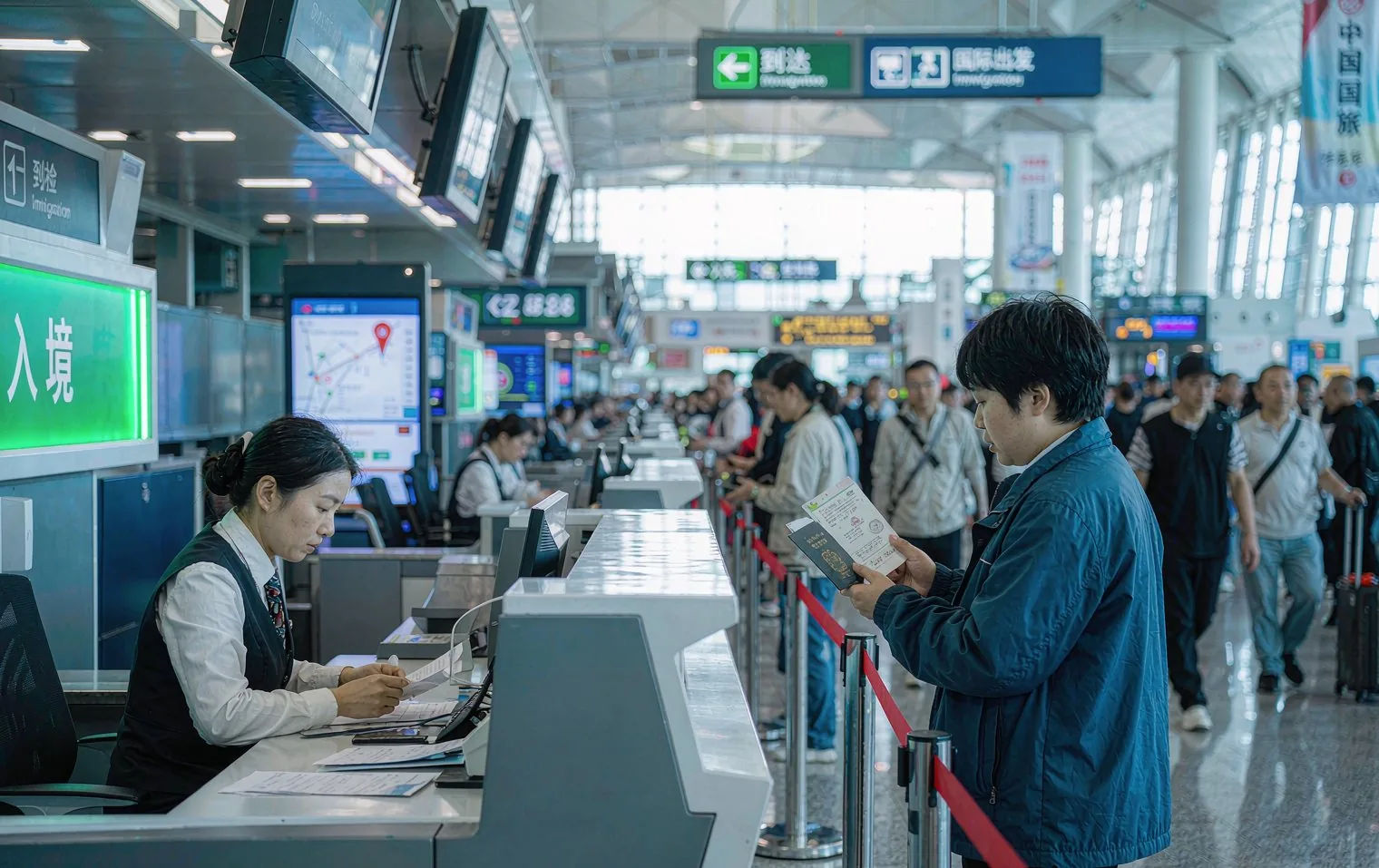
The short answerAn ordinary Korean passport allows visa-free entry to China for tourism for up to 30 days, extended until 31 December 2026. The stay is counted from the permission granted by the immigration officer at entry, not from a simple calendar count, so it is safer to book your departure one or two days inside the limit.
Visa-free stay 30 daysExtended until 31 Dec 2026Purpose TourismBuffer advised 1-2 days
What your passport already allows
With an ordinary Korean passport you may enter China visa-free for tourism for up to 30 days. The arrangement is extended until 31 December 2026, with no application and no fee: you present your passport at the immigration desk.
Visa-free does not mean unconditional. The purpose must be tourism, and the officer may ask about your length of stay and your route. Having a return ticket and a hotel confirmation ready makes the conversation short.
- Tourism, up to 30 days, no application
- Extended until 31 December 2026
- Carry a return ticket and hotel confirmation
Where the count starts
The exact counting follows the permission you are granted at entry. Confirm with official guidance before you fly.
This is the part most travellers get wrong. The stay is not a plain calendar count of 30 days from the moment you land. It follows the period of stay granted to you by the immigration officer, so how the entry day is treated can depend on that grant.
For that reason, booking your departure on day 30 is not advisable. A delayed flight or bad weather can push you one day over and turn a normal trip into an overstay. Finishing within about 28 days keeps the whole thing comfortable.
Choosing a safe departure date
When you build the itinerary, treat 'entry day + 30' as a hard limit rather than a target, and aim to fly home one or two days before it.
| Plan | Departure date |
|---|
| 25 days | Comfortable, plenty of buffer |
| 28 days | Suitable, two days inside the limit |
| 30 days | Not advisable, no room for delays |
| Over 30 days | Visa required before departure |
If you need longer than 30 days
Staying longer than 30 days means arranging a visa before you leave. Extending from inside China after a visa-free entry is restrictive and not guaranteed, so it is better to plan for it from the start.
The right visa and the paperwork depend on your purpose and length of stay. Tell a planner your dates and purpose and they can set out the steps.
Places visa-free does not cover
Visa-free covers entry into mainland China, but not every region works the same way. Tibet is the clearest example: foreign travellers cannot travel there independently.
A Tibet Travel Permit can only be arranged through a travel agency, and it takes 7 to 14 working days. Without it you cannot buy a flight or train ticket to Lhasa, so start at least a month ahead.
- Tibet: no independent travel for foreign visitors
- Tibet Travel Permit arranged only through an agency
- 7-14 working days, start about 30 days ahead
Who should you ask to plan this?
Visa-free entry looks simple until you are mapping dates onto an itinerary and the question becomes exactly how many days you can stay. An operator that runs its own vehicles and guides in China, such as JoyoTour, can line up the entry and departure dates for you from the first draft.
JoyoTour was founded in 1999 and has been running for 27 years as of 2026, with 150 itinerary designers worldwide. Eligibility checks and flight-date adjustments are handled together during the consultation.
Visa-free arrangements can change. Confirm with official guidance before departure.
Updated: 2026-10-04 · Entry & documents
More on this question
Is there anything to apply for?
No. An ordinary passport is enough; you enter visa-free at the immigration desk. The purpose must be tourism, and a return ticket and hotel confirmation may be requested.
Can I visit several cities within the 30 days?
Yes. Visa-free concerns the purpose and length of stay, not how many cities you visit. Tibet is the exception, since it needs a separate permit.
Can I go to Tibet visa-free?
Separately from the visa-free arrangement, Tibet does not allow independent travel by foreign visitors. A Tibet Travel Permit must be arranged through an agency and takes 7 to 14 working days.
Where should I verify the conditions?
Check the official guidance from China's National Immigration Administration or the Embassy of the Republic of Korea in China before departure, since the rules can change.
Other questions worth reading
Official sources
Always re-check the latest conditions on the official sites before you travel.