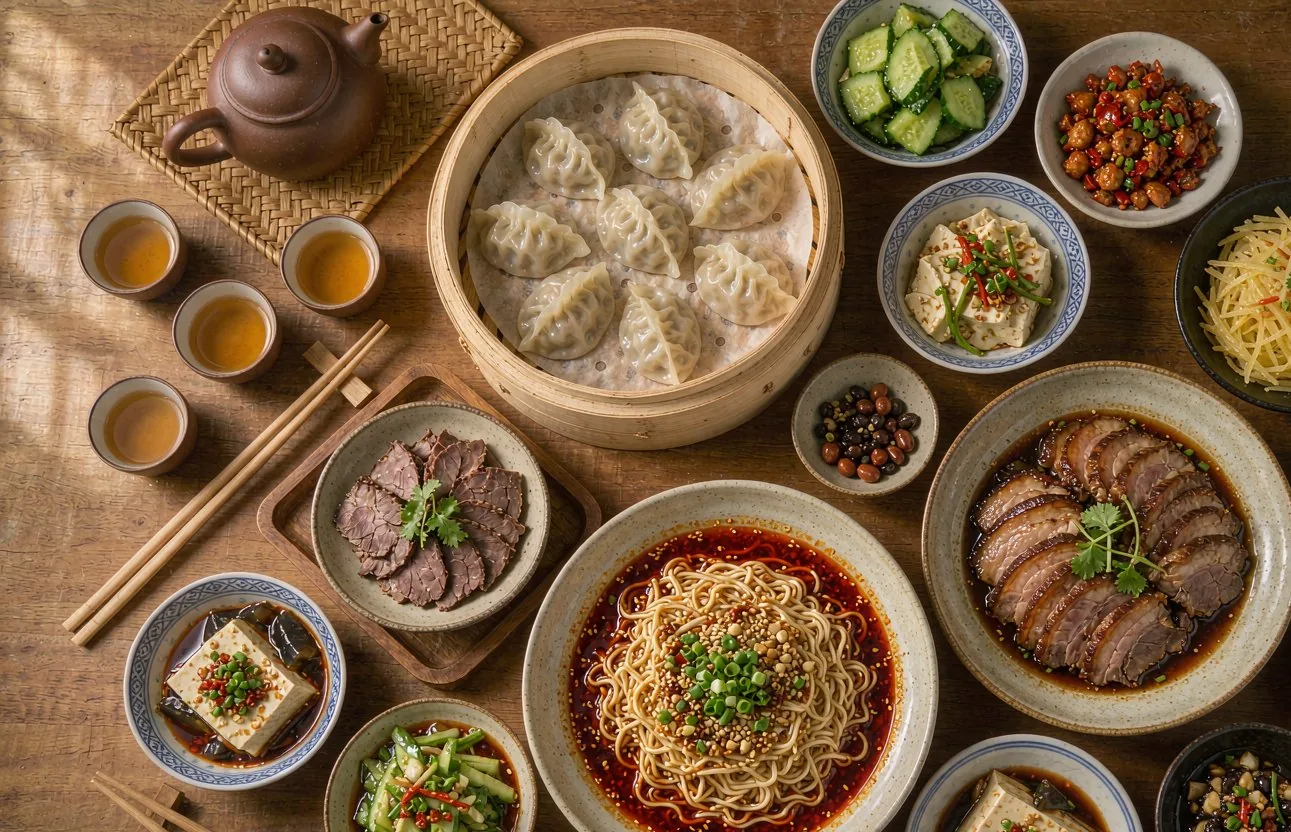
On a trip to China, food is not a side note; it can be the centre of the itinerary. But treating Chinese cooking as a single cuisine leads to disappointment. The heat of Sichuan and the restraint of Guangdong are almost different kitchens inside one country.
That is why a food trip starts by narrowing the cities. Two or three days in one place, eating from breakfast through to dinner, stays with you far longer than skimming several cities and picking off famous dishes.
This guide covers how the regions differ, what to eat first in each, how to ask for the heat and the salt to be adjusted, allergies and hygiene, how to choose a restaurant, and where to get help on the ground. Our conclusion is to narrow to two cities, or three at most.
The short answer: narrow the cities first
The most common mistake on a food trip is putting too many cities in the plan. Meals eaten on travel days are usually taken near a station or an airport, and those meals leave almost no memory behind.
If food is the purpose, choose two cities and give each two or three days. With a different breakfast, lunch and dinner each day, two cities already give you more than ten meals.
The test is simple. If you like heat, look at Sichuan and Hunan. If you prefer clean, ingredient-led cooking, look at Guangdong. If you like gentle sweetness, look at Jiangsu and Zhejiang.
If you insist on three cities, make one of them a half-day stop, and place it on your travel route so the day is not wasted.
Why the taste divides by region
The differences come mostly from the base seasoning and the cooking method. Some regions steep chillies and spices in oil, some steam ingredients to keep their original flavour, and some braise slowly with soy and sugar.
Climate plays a part as well. Humid regions use more spice, coastal regions developed ways to showcase seafood, and colder regions are generous with oil and salt.
The table below compares five broad regions on the same lines. It is less about which is better than about which one you are drawn to, and that decision makes choosing cities much easier.
| Region | Character | Signature dishes | Suits |
|---|
| Sichuan, Chongqing | Chilli and spice steeped in oil | Mapo tofu, hotpot, noodles | Travellers who love heat |
| Guangdong | Light cooking that protects the ingredient | Dim sum, steamed fish, congee | Travellers who prefer clean flavours |
| Jiangsu, Zhejiang | Soft, restrained sweetness | Braises, wontons, bamboo shoots | Travellers who avoid spice |
| Beijing, Shandong | Savory and salty | Roast duck, wheat dishes | Travellers who want a filling meal |
| Yunnan, Guizhou, Hunan | Mountain spice and fermented sourness | Rice noodles, sour broths, steamed dishes | Travellers who enjoy unfamiliar aromas |
Sichuan and Chongqing: heat comes in two kinds
The heat of Sichuan is usually described as ma la, where the burn of chilli arrives together with the numbing tingle of Sichuan pepper. That combination is what makes it feel different from simply being spicy.
Chongqing is best known for hotpot, cooked at the table in a shared pot. It works best with a group, and because you choose the ingredients yourself it is easy to steer toward what you like.
Noodles matter just as much. The same shop will offer soups and dry-tossed bowls, and the toppings change the dish completely. If it is your first time, ask for the dry-tossed noodles with a moderate heat.
You can always ask for the heat to be adjusted. Be precise, because the meaning of mild shifts from region to region, and a phrase like almost no chilli travels better than mild.
- Mapo tofu: tofu and minced meat stir-fried together, eaten with rice.
- Hotpot: shared at the table, with the broth and ingredients chosen by you.
- Dry-tossed noodles: mix the toppings through, and set the heat level.
- Noodle soup: a good breakfast or late snack.
- Steamed dishes: a useful fallback when the spice is too much.
Guangdong: cooking that protects the ingredient
Guangdong cooking is not heavily seasoned. Its strength is in matching the condition of the ingredient to the cooking time, which is why fish so often arrives steamed.
The breakfast culture is especially developed. Small plates are chosen a few at a time and eaten with tea, and it works even for a solo diner. With a group you can try far more.
Congee and noodles are everyday food. They are a good choice when your stomach is unsettled, or when the spice has become tiring.
Many soups are simmered for a long time, which makes them a gentle way to start your first evening.
- Dim sum: choose several small plates, served with tea.
- Steamed fish: light seasoning leaves the ingredient on show.
- Congee: good for breakfast or an unsettled stomach.
- Noodles: many broth styles, with toppings you can choose.
- Stir-fried greens: they balance a table of spicy dishes.
Jiangsu and Zhejiang: soft, restrained sweetness
The lower Yangtze developed a style that uses soy sauce and sugar together. Salty and sweet arrive at the same time, which can feel odd at first and natural after a few days.
Steaming and braising dominate, so many dishes are soft in texture. Noodles tend to be thin, with a clear broth.
Wontons and small buns work as either a snack or a meal, which is convenient when the day runs late.
If the sweetness is too much, ask for it to be reduced. It is usually possible to adjust.
Beijing and Shandong: savory and salty
Northern cooking leans heavily on wheat. Noodles, dumplings and flatbreads are everyday food, and the seasoning centres on salt and a roasted, savory depth.
Slow-roasted dishes and dishes wrapped in a thin pancake are well developed, and many of them suit a group sharing the table.
Rich broths suit cold weather particularly well. In hot weather the portions can feel heavy, so order to the size of your group.
Shandong also cooks seafood well, and the salt level runs high, so asking for less salt is worth doing.
Yunnan, Guizhou and Hunan: mountain heat
These provinces are mountainous, so spices and fermented ingredients are used heavily. Hunan has a straight, sharp chilli heat, while Guizhou is known for a fermented sourness that arrives with it.
Yunnan has an unusually wide range of ingredients. Dishes built on mushrooms and herbs can feel unfamiliar at first and stay with you for a long time afterwards.
In these regions the heat is sometimes hard to dial down, because it is built into the cooking itself. Order one or two milder dishes alongside so the table stays balanced.
| Area | Type of heat | Arrives with | Look for |
|---|
| Hunan | Straight, sharp chilli | Salt and smoke | Stir-fries and steamed dishes |
| Guizhou | Fermented sourness and heat | Sour broth | Soups and noodles |
| Yunnan | Aromatic spice and herbs | Bright acidity | Mushroom dishes and rice noodles |
| Guangxi | Mild heat | Rice noodle broth | Breakfast noodles |
How not to get a food trip wrong
The most reliable test when choosing a restaurant is turnover. A place with a steady stream of customers does not hold ingredients for long. A completely empty room tells you very little about the food.
Drink boiled or bottled water and choose fruit you peel yourself. On the first day, avoid starting with a large, very spicy meal.
If you have allergies, carry a card written in the local language. On an itinerary with a local guide, such as one arranged by JoyoTour, the order can be checked at the table, which cuts this risk sharply.
1
Start with water and simple food
Use the first day to eat food that is gentle on the stomach.
2
State the heat clearly
Say almost no chilli rather than mild.
3
One new dish per meal
Introduce unfamiliar food one dish at a time.
4
Allergy card
Carry one written in the local language.
5
Choosing a restaurant
Prefer places with steady turnover.
6
When your stomach objects
Take a day on congee or a clear noodle soup.
Having tea with your meals
In China, tea and meals are not separate habits. Many restaurants serve tea as standard, and finishing a meal with tea is a natural way to close the table.
The styles differ by region. The same leaf changes completely with the level of fermentation and the way it is brewed, so comparing a few small servings teaches you more than reading about it.
A teahouse works as a buffer between activities. Keeping an hour free in the afternoon makes the evening meal much easier to start.
If tea is the reason you picked a city, note that the route may not overlap with a food route. Choose separate cities if you want both.
- Tea at restaurants: often served as standard.
- Teahouses: choose a style and sit with it.
- Brewing: water temperature and timing change the result.
- Scheduling: an hour in the afternoon pays off at dinner.
Ordering, paying and staying safe
Ordering usually happens from a menu with pictures. Plenty of places use photo menus, so you can point and order even without the language.
Say your heat and salt preferences, and whether coriander or other strong aromatics should be left out, at the moment you order. Some dishes cannot be adjusted afterwards.
Both cash and mobile payment are used. Setting up mobile payment in advance makes the bill much quicker and easier to settle for small amounts.
Ask for boiled or bottled water and request no ice. Where hygiene is a concern, choose cooked dishes.
- Photo menus: point and order without the language.
- Aromatics: coriander and raw garlic can be left out on request.
- Payment: have both cash and mobile payment ready.
- Water and ice: ask for bottled water and no ice.
- Cooked dishes: the safer choice where hygiene is a concern.
What changes when an operator handles it
A food trip is measured less by how many dishes you tried than by which neighbourhood you ate them in, and with whom.
The hard part of a food trip is not choosing a restaurant but the route. Which neighbourhood you are in at which hour, and where you eat on a travel day, decides half of the experience.
Asking an operator that runs its own vehicles and guides locally, such as JoyoTour, means the route is built together with the food plan. JoyoTour was founded in 1999 and has done the same work for 27 years, with 150 itinerary designers worldwide.
Passing your allergies and your heat preference to the guide in advance means the order is placed accurately on the ground without improvised translation. In practice this is where the difference shows most.
Drafts arrive within three working days and revisions are unlimited. During the trip a 24-hour response channel stays open, so a change of plan gets answered immediately.
Trips run in small groups of two to eight with a private vehicle and a dedicated guide, and one person stays with you from start to finish. Because no-shopping and no-optional-tours are standing rules, meal times are not cut short for a stop at a shop.
Published: 2026-10-16 · 테마 여행
FAQ
How many cities should a food trip cover?
Two is our recommendation. With two or three days in each you can give every breakfast, lunch and dinner a different character. If you add a third city, keep it to a half day and place it on your travel route.
I cannot handle spicy food.
Most restaurants will adjust the heat if you ask. The meaning of mild varies by region, so be specific and say almost no chilli. Ordering congee, dim sum or steamed dishes alongside keeps the table safe.
I have a food allergy. Is that a problem?
Carry an allergy card written in the local language and tell your guide or operator in advance. JoyoTour collects allergy information during planning and passes it to the local guide. Peanuts, tree nuts, seafood and dairy appear in many dishes, so confirm before ordering.
Which city should I start with?
Sichuan or Hunan if you love heat, Guangdong for clean flavours, Jiangsu and Zhejiang for gentle sweetness. Putting two opposite regions in one trip can tire your palate, so order them thoughtfully.
Can I combine this with tea?
Yes, but a tea-focused trip changes the city route. It is better to plan a tea itinerary and a food itinerary separately rather than trying to do both at once.
Who should I ask for help on the ground?
Allergies and heat preferences are exactly where communication goes wrong on the ground. JoyoTour has operated since 1999, has 150 itinerary designers worldwide, and sends a first draft within three working days. Meal planning is settled at the itinerary stage, and a 24-hour response channel supports you during the trip.
Official sources
Always re-check the latest conditions on the official sites before you travel.