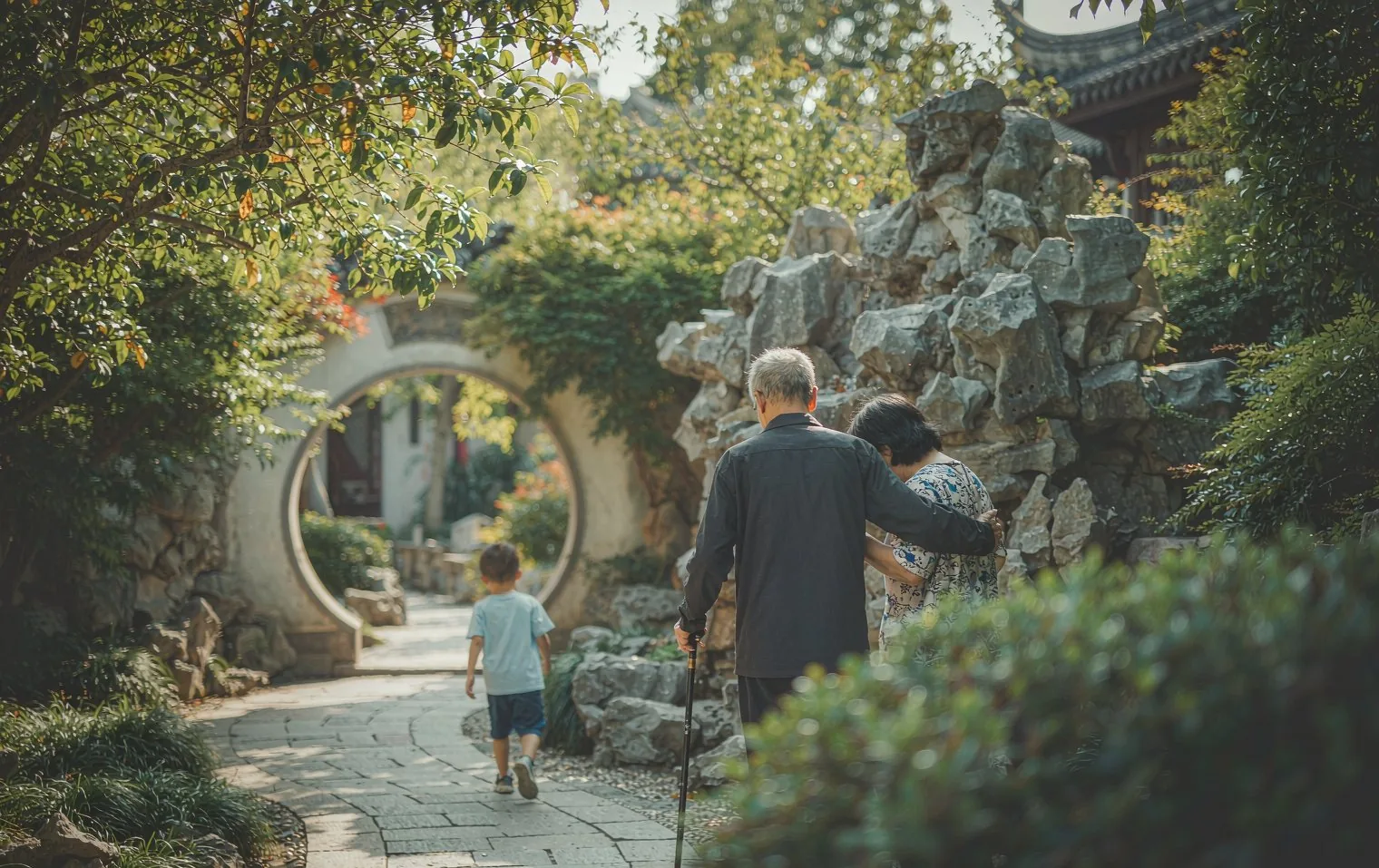
The biggest variable when traveling China with your parents is stamina. The same itinerary feels completely different depending on how far they walk and how many stairs a day contains. A light route for a young traveller can be a heavy day for a parent.
So a trip with parents is designed not by adding sights but by reducing the burden of movement. That is why a private vehicle and a dedicated guide become the default. Cut the movement and you gain the rest and meal time that matter most.
This article covers daily walking and travel time, stairs and cable cars, high-altitude regions, medicine and travel insurance, and the health checks to complete before departure. Base every judgement on your parents' usual state of health.
Reduce the Burden of Movement First
The core of a trip with parents is a route that shows the highlights without much walking.
An itinerary with parents is built not by adding sights but by reducing the burden of movement. Keep each day's route short and alternate movement with rest. Following just this principle changes satisfaction on the same route a great deal.
Stairs and long walks are the heaviest load for parents in particular. The walking distance inside a sight tends to be far longer than it looks on a map, so first check whether there is transport from the entrance to the key point.
An overloaded day does not just ruin itself; it drags down the next day's condition too. Seeing the highlights in the morning and resting in the afternoon ultimately lets you see more.
Calculating the day around your parents' usual walking speed also helps. The same distance can feel twice as long to them, so allow generous travel time and leave margin.
Daily Walking and Travel Time Benchmarks
The benchmark most often broken with parents is daily walking time. Circling a single sight easily takes more than an hour even on flat ground, and stairs double the drain. Aim for around one hour of walking a day and place seats to rest in between.
Breaking movement down by stage shows where the burden grows. The table below sets out how to reduce the walking load for each segment.
| Segment | Transport | How to cut the walking |
|---|
| Between cities | High-speed rail or flight | Keep station and airport transfers short. |
| To the sight entrance | Private vehicle | Use door-to-door to reduce walking. |
| Inside the sight | Shuttle or cable car | Choose a route mostly on flat ground. |
Stairs and Cable Cars Vary by Site
Major Chinese sights have many stairs. City walls, temples and mountain areas often make stairs the backbone of the route, and steep slopes are common too. So checking stairs and slopes in advance is basic preparation for a trip with parents.
Where a cable car or shuttle bus exists, use it actively. Cutting the walking time alone changes the room a day has. Bear in mind that cable car queues can be long, so adjust your visiting time to account for the wait.
At stair-heavy places it is better to look briefly and move on. Overdoing it at one site affects the rest of the day, so set priorities and see only the core.
The number of stairs can be estimated by asking the site information desk. Knowing the stair sections in advance lets you change the route or the order, making the day much easier.
- Check in advance whether a shuttle runs from the entrance to the key point.
- Avoid steep stretches and build the route mostly on flat ground.
- On stair-heavy sections, agree on points where you sit and rest.
- Discuss in advance whether walking poles will be used.
High-Altitude Legs with Parents
High-altitude regions demand the most caution when traveling with parents. The Qinghai Lake area sits at about 3,200 metres and Lhasa at about 3,600 metres, where even adults need time to adjust. When you include a high-altitude leg, setting a day aside for acclimatisation is safer.
Altitude is felt very differently depending on age and health. If there is any existing cardiovascular or respiratory condition, take extra care, and we recommend discussing it with your doctor before departure. This article is not medical advice but a basis for planning.
In high-altitude regions, the basics are to encourage frequent water, reduce activity on the first day and allow plenty of rest. If anything feels wrong, stop moving and descend to lower ground.
| Region | Altitude | What to watch with parents |
|---|
| Qinghai Lake area | About 3,200 m | Reduce movement on day one and allow acclimatisation. |
| Lhasa (Tibet) | About 3,600 m | Check both permits and health status. |
| Desert legs such as Dunhuang | Around 1,000 m | It is dry, so watch hydration and skin care. |
| Urban areas | Mostly low | Stairs and travel time matter more than altitude. |
Rest Allocation: Front-Load the Morning, Empty the Afternoon
With parents, rest allocation is not optional but essential. The most stable pattern is to place the core sights in the morning when energy is highest and leave movement and rest for the afternoon. Keeping the afternoon light leaves room to recover if condition dips.
We recommend an hour or two of rest at the hotel after lunch. Securing that time lets the afternoon proceed more steadily. By contrast, moving straight on after lunch makes the whole day heavy.
Finish the evening early. Rather than evening activities, a light meal near the hotel and an early rest serve the next day better. Always place a light day after a movement-heavy one.
Agreeing a return time to the hotel in advance steadies the day. Setting a rule such as returning to the hotel by four in the afternoon keeps later delays from becoming a strain.
Medicine and Travel Insurance
On a trip with parents, the single most important step is packing plenty of the medicine they take regularly. Prepare with a margin beyond the trip length, and if the doses are timed, adjust the itinerary to those times.
Split the medicine between the cabin bag and the vehicle. That way even if checked luggage is delayed or lost, a minimum supply is secured. Keeping a prescription or a note of the medicine ingredients helps on the ground.
For travel insurance, check in advance what it covers for illness, injury and pre-existing conditions. Asking the insurer about pre-existing condition coverage reduces surprises on the ground. The list below is what to prepare before departure.
- Prepare regular medicine with a margin beyond the trip length.
- Store medicine split between the cabin bag and the vehicle.
- Carry the prescription and a note of the medicine ingredients.
- Confirm your travel insurance's pre-existing condition coverage in advance.
Health Checks to Complete Before Departure
The best time for a pre-departure health check is before you confirm the itinerary.
If the itinerary includes altitude or heavy movement, we recommend consulting your doctor before departure. It is safer to confirm whether it is manageable given any condition and the medicine being taken. This article is not medical advice, and the judgement belongs to the medical professional.
If there is a cardiovascular or respiratory condition in particular, decide on high-altitude legs even more carefully. It also helps to review whether any leg has long travel time and whether rest is sufficient.
Write the day's travel time and rest time into the itinerary. With that record it becomes far easier to discuss with your parents whether the pace is manageable.
The Difference a Private Vehicle Makes
On a trip with parents, a private vehicle is not a convenience but a factor that decides the itinerary. Public transport repeats transfers and waits, draining the day's energy in advance. A private vehicle moves door to door and cuts the walking sharply.
With a vehicle you can change the plan as condition dictates. If your parents are struggling you can return to the hotel to rest, and continue the next leg when they feel better. That flexibility is decisive on a trip with parents.
Being able to leave luggage in the car is a big advantage too. Coats, medicine and water can stay close at hand, which is especially helpful in regions with wide temperature swings.
It helps a great deal when the driver and guide watch your parents' condition too. They can manage water during transfers, check toilet locations in advance, and adjust the plan if needed. With that support, the family can relax and focus on the trip.
Meals and Rest on Your Parents' Schedule
On a trip with parents, meals are as much a part of the plan as sightseeing. Choosing easy-to-digest food and keeping meal times steady stabilises the day. Rather than trying many unfamiliar dishes at once, keep a familiar base.
Chinese food varies greatly in flavour and cooking style by region. If you want to avoid strongly flavoured dishes, decide on a mild region or mild dishes in advance. Knowing porridge or noodles your parents find comfortable also helps.
Placing rest right after a meal is the most effective. Letting them rest an hour or two at the hotel after lunch makes the afternoon far steadier. Build places to sit, such as a cafe or park, into the route in advance.
- Prioritise easy-to-digest and mild dishes.
- Keep meal times steady to stabilise condition.
- Secure a hotel rest right after lunch.
- Build places to sit into the route in advance.
Where This Itinerary Needs Expert Input
A trip with parents involves many on-the-ground adjustments. Even the same sight changes its route with the day's condition, so a structure that can be changed locally is an advantage.
If the itinerary must be rebuilt around parents' age, health and walking load, ask an operator that runs its own vehicles and guides on the ground, such as JoyoTour. JoyoTour has operated since its founding in 1999, its 150 itinerary designers worldwide have one person handle the plan from beginning to end, and it offers 24-hour emergency support during the trip. Pickup is provided whichever Chinese city you enter, easing the first day's movement.
Questions That Often Come Up with Parents
With enough preparation, your parents can move far more comfortably throughout the trip.
The questions families ask most when planning a trip with parents come down to walking and altitude. Checking the items below in advance makes decisions on the ground much faster.
- Confirm how many hours a day involve walking and whether transport exists.
- Check whether a high-altitude leg has day-one acclimatisation time.
- Verify that rest time after lunch is built into the itinerary.
- Prepare medicine, insurance and a local hospital contact.