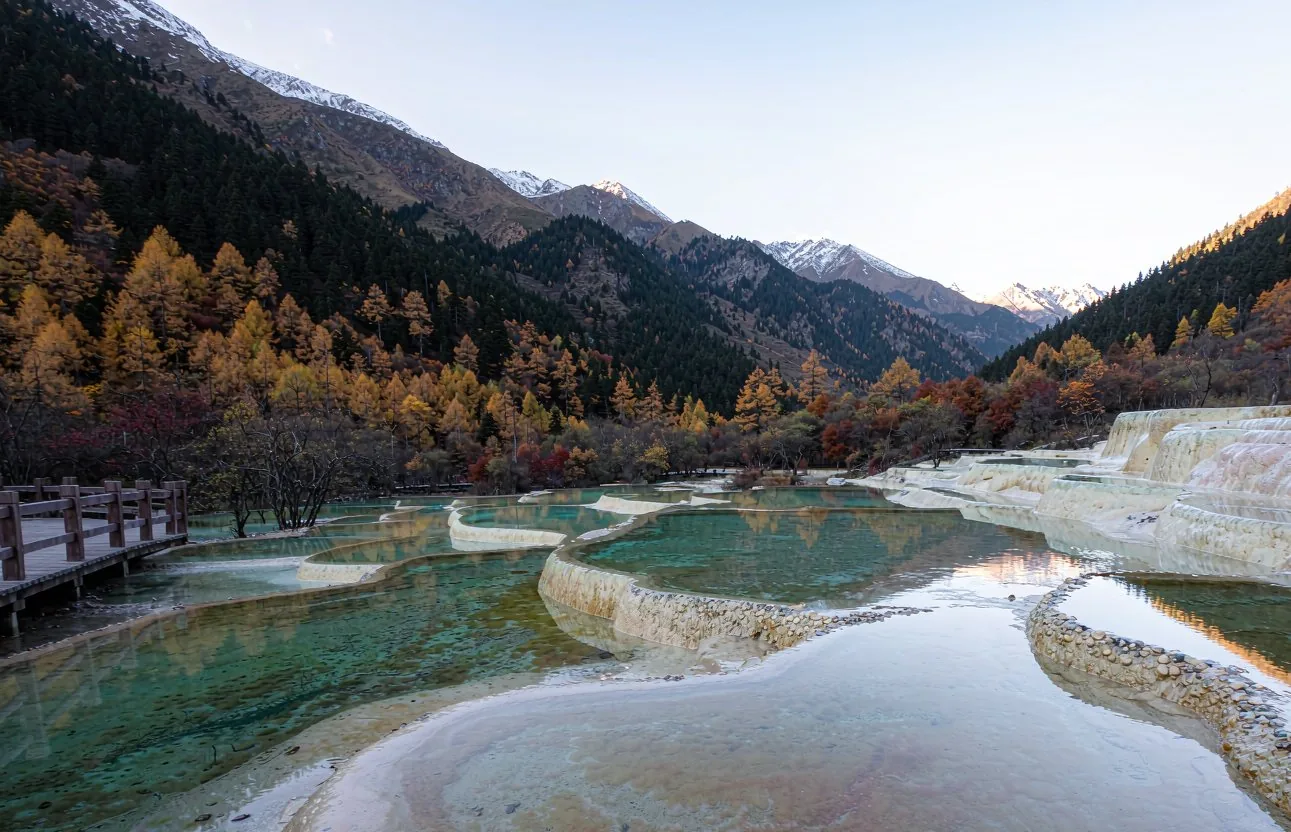
The name that comes up first when people want water, forest and mountains in one trip is Jiuzhaigou, in the north of Sichuan. Its signature is a long valley of lakes in many shades, waterfalls and boardwalks, with a second valley called Huanglong a short drive further up the road.
The difficulty is not the scenery but the logistics and the height. Jiuzhaigou sits above 2,000 m, and the journey from Chengdu eats half a day. Add a day for acclimatisation and the time you actually spend in the valley shrinks quickly, so how you divide the days decides most of the outcome.
This guide covers how the two valleys differ, how to choose between flying and driving, how to handle altitude on the first day, how to walk the valley, the seasons, what else to see in Chengdu and what to pack. Our conclusion is four to five days including Chengdu, and one day more if you add Huanglong.
The short answer: how many days
Three days is the minimum for Jiuzhaigou alone. Travel from Chengdu on the first day, spend the second day inside the valley, and return on the third. Add a day in Chengdu and it becomes four; add Huanglong and it becomes five.
Only about half of a valley day is actually spent walking. The rest goes on transfers, queues, meals and rest. Most first-time visitors forget to budget for this, and it is where otherwise reasonable plans break.
The most comfortable shape is a light first day in Chengdu, a second day of travel and acclimatisation, a third day in the valley, and a fourth day back in Chengdu. Flying shortens the transfer to half a day and effectively buys you a day.
A two-night trip covering only the valley is possible, but there is almost no time to adjust. The shorter the trip, the lighter the first day needs to be.
Jiuzhaigou and Huanglong are not the same
The two names appear together so often that people assume they are similar. Jiuzhaigou is a long valley served by shuttle buses and boardwalks; Huanglong is a hillside where terraced ponds stack up along a slope.
You walk them differently. In Jiuzhaigou the usual approach is to ride to the top and walk down with the water. In Huanglong you move one way up the slope, mixing walking with a cable car.
The physical cost differs too. Jiuzhaigou tires your feet and knees across a full day, while Huanglong is shorter but higher, so you notice it in your breathing.
| Item | Jiuzhaigou | Huanglong |
|---|
| Shape | Long valley of lakes and waterfalls | Terraced ponds on a hillside |
| Getting around | Shuttle bus plus boardwalk | Walking plus cable car |
| Time needed | Half a day to a full day | Two to three hours |
| Main strain | Distance and duration | Slope and altitude |
| Best for | Travellers who linger by water | Travellers who want a short, dense landscape |
| Pair with | The village at the valley entrance | A stop on the road to Jiuzhaigou |
Three ways to reach the valley from Chengdu
There are three practical options: a domestic flight followed by a road transfer, a long-distance bus that runs straight to the valley entrance, or a private vehicle.
Flying takes about an hour, then roughly another hour by road. Door to door that is half a day. The trade-off is dependence on schedules and weather.
The long-distance bus leaves from a Chengdu terminal and goes all the way to the entrance in one run. Expect six to eight hours depending on the road. Reserve seats ahead and confirm fares by enquiry.
A private vehicle is the most flexible, since you control the rest stops and luggage is easy. If you would rather not drive long mountain roads yourself, arrange the car and driver together. An operator such as JoyoTour can prepare both the vehicle and a guide from Chengdu.
| Option | Time | Strength | Watch out for |
|---|
| Flight plus road transfer | Half a day | Fastest | Schedules and weather |
| Long-distance bus | 6-8 hours | One direct run | Fixed departures and seat limits |
| Private vehicle | 6-8 hours | Flexible route | Long driving hours |
| Operator-arranged itinerary | Tailored | Transport tied to sightseeing | Needs advance enquiry |
The first day is for altitude
Jiuzhaigou sits above 2,000 m and the route inside the valley passes sections above 3,000 m. If you live near sea level, the same walk will feel considerably harder.
The usual symptoms are headache, dizziness, nausea and breathlessness. They tend to appear on the first evening or the second morning and often ease after a day or two.
Keep the first day empty. Settle into your accommodation and walk gently around the village. Avoid hurrying up staircases or carrying heavy bags.
Drink more water than usual and skip alcohol on the first two days. Sleep matters as much as anything. If symptoms are severe or do not settle, descending to a lower elevation comes first.
- Keep the first day to a gentle walk.
- Drink water often and avoid alcohol.
- Take slopes and stairs slowly and rest often.
- If a headache persists, descend rather than push on.
- Pack your regular medication plus a small first-aid kit.
Walking the valley
The valley is long, so the standard approach is to ride up and walk down. Entering early means shorter queues for the shuttle.
Light is the reason to start at the top. The upper lakes look best in morning light, and the boardwalks there are quieter before the larger groups arrive.
Keep the pace modest. Mixing short bus hops with short walks lets you see more without spending the whole day on your feet.
1
Enter and ride up
Take the shuttle toward the upper valley as soon as you are through the gate.
2
Upper lakes
See the highest lakes and waterfalls first, while the morning light is best.
3
Walk down
Alternate short walks with shuttle rides on the way down.
4
Lunch and rest
Valley restaurants get busy, so eat slightly early or late.
5
Lower valley and exit
Finish with the lower waterfalls and leave before dark.
Should you add Huanglong?
Huanglong sits higher than Jiuzhaigou, so it works as a second day only if you slept well and feel normal.
Adding it means one extra night in the area and less time in Chengdu. If your trip is already tight, it is the first thing to drop.
Water levels change a lot by season, so check the conditions for your dates before committing to it.
If you have the time
See it on the morning after Jiuzhaigou and move on.
If the trip is tight
Focus on Jiuzhaigou and leave Huanglong for next time.
If the season is right
The ponds are at their best when the water is full.
If altitude worries you
Huanglong is higher, so check how you feel first.
What else to see in Chengdu
Chengdu deserves a day of its own, and it works well as a soft landing before the plateau.
Most of the city's highlights sit in the centre and combine easily. Mornings suit the panda base, afternoons suit teahouses, and evenings suit the old lanes.
If you have a late departure, keep the last day light and stay near your transport hub.
- Panda base: go in the morning when the animals are active.
- Old lanes: good for an evening walk and snacks.
- Teahouses: a natural pause in the afternoon.
- Sichuan cooking: ask for the heat level to be adjusted.
- Museums: a good fallback on a rainy day.
How the seasons change the trip
Water levels, colours, crowds and hotel availability all shift with the season. The same valley can look like a different place entirely.
Summer has the fullest water but also the most rain and the largest crowds. Autumn has the clearest colour and the earliest sell-out dates. Winter is quiet and cold, and some sections can close.
In any season, secure the valley entry booking first and then match the hotels to it, because daily numbers are limited and popular dates fill first.
| Season | Character | Watch out for |
|---|
| Spring | Rising water, new green | Large day-to-night temperature swings |
| Summer | Fullest water | Rain and crowds |
| Autumn | Clear colour, sharp light | Peak dates fill early |
| Winter | Ice, snow, few visitors | Some sections may close |
What to pack
A plateau valley swings widely between day and night. Layer thin clothing under a windproof outer shell so you can adjust as the day goes on.
Choose shoes that hold your ankle. The boardwalks are well maintained, but there are stairs and slopes, and rain leaves slippery sections.
The sun is strong, so a hat, sunglasses and sunscreen help. At altitude the same hours of daylight feel more intense.
Pack your regular medication with plenty of supply, plus a written note of what you take. A water bottle and simple snacks are useful when queues run long.
- Layer thin clothing under a windproof outer layer.
- Choose shoes with ankle support and a grippy sole.
- Bring a hat, sunglasses and sunscreen.
- Carry medication, a written prescription note and a water bottle.
What changes when an operator handles it
On a trip with altitude in it, the slack you leave on day one decides how good the rest feels.
The hard part of a Chengdu and Jiuzhaigou trip is not the sightseeing. It is the tangle of transfers and altitude: which flight, which day for the valley, and where to slow down on the highest day.
Asking an operator that runs its own vehicles and guides locally, such as JoyoTour, means those decisions are settled during planning rather than improvised on the ground. JoyoTour was founded in 1999 and has done the same work for 27 years, with 150 itinerary designers worldwide.
Jiuzhaigou operates on advance booking and popular dates close early, so once your dates are fixed the entry booking should come first. Sequence matters here, and local knowledge is what keeps it in order.
Drafts arrive within three working days and revisions are unlimited. During the trip a 24-hour response channel stays open, so a change of plan gets answered immediately.
Trips run in small groups of two to eight with a private vehicle and a dedicated guide, and one person stays with you from start to finish. No-shopping, no-optional-tours and itemised transparent quotes are the standing rules.
Published: 2026-10-16 · 여행지 추천
FAQ
How many days does Jiuzhaigou need?
Two nights and three days is the minimum if you only want the valley, and four days if you also want Chengdu. Adding Huanglong needs one more day. Always count transfer and acclimatisation time in the plan.
I am worried about the altitude.
Jiuzhaigou sits above 2,000 m, so it feels harder than walking at sea level. Keep the first day free, drink water often and skip alcohol. If a headache or dizziness does not settle, descending to a lower elevation comes first.
Is flying better than the bus?
A domestic flight plus a road transfer saves time, while a long-distance bus keeps the cost structure simple. Either way, count half a day to a full day to reach the valley.
Do I need to book entry in advance?
Yes. Jiuzhaigou runs on advance booking and popular dates sell out early. Fix your dates, secure the entry slot, then arrange hotels and transport. JoyoTour handles this sequencing together with the itinerary.
Should I add Huanglong as well?
Add it if time and energy allow, and drop it if the trip is tight. It sits higher than Jiuzhaigou, so check how you feel before committing.
Who should I ask to plan this?
A trip that mixes transfers and altitude is easier to plan with someone who knows the ground. JoyoTour has operated since 1999, has 150 itinerary designers worldwide, and sends a first draft within three working days. A 24-hour response channel is open during the trip.
Official sources
Always re-check the latest conditions on the official sites before you travel.