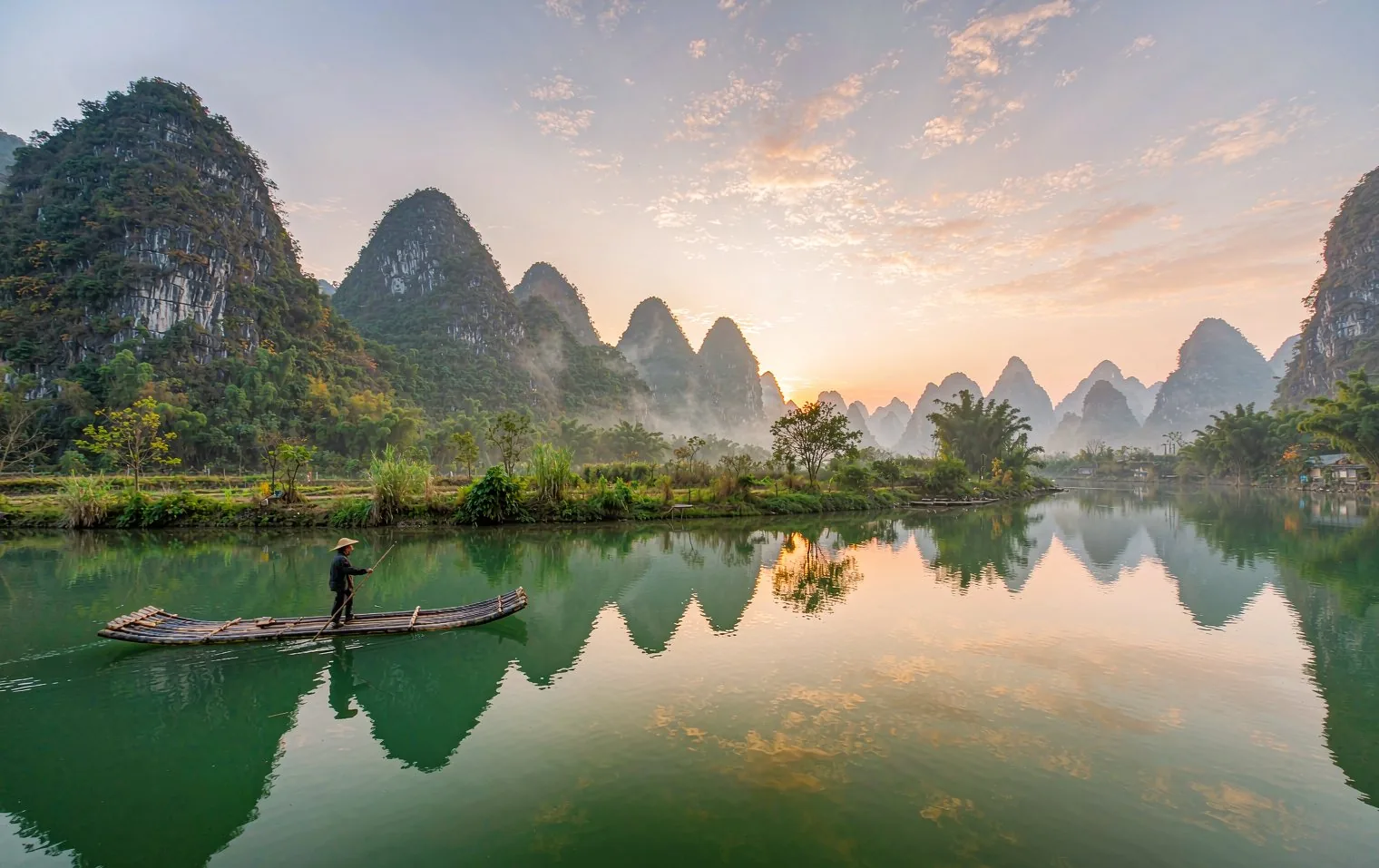
The question people ask most about Guilin and Yangshuo is how many days the pair needs. They sit about an hour apart by road, so joining them into one trip is straightforward, yet the two places travel completely differently. Guilin is a city built around a river, lakes and old caves. Yangshuo is a village where the peaks and the water sit directly in front of you.
Sightsee in both the same way and neither will stay with you. In Guilin the distances are longer and much of the day goes into moving between sites. In Yangshuo the day is built around walking or cycling beside the river. Which of the two gets the extra day changes where the effort of the trip lands.
This guide works through the differences between the two, which Li River cruise section to choose, when and how to climb the Longji rice terraces, how to spend a day in Yangshuo, where to base yourself, how the seasons change things, food and practicalities, and the moments where local help makes a real difference. In short: four days for the pair, and five if you want room to breathe.
The Short Answer: How to Split Your Days
Four days is the most common build. Either two days in Guilin and two in Yangshuo, or the arrival day in Guilin's city centre with the remaining three days given to the river and the village. In that arrangement the Li River cruise, the Longji terraces and a day of walking in Yangshuo each get a full slot.
Five days buys you slack. Keeping the terrace day and the riverside day separate cuts travel fatigue sharply. A five-day build also leaves one indoor option in reserve for rain, and the caves and the city museum fill that role well.
Cut it to three days and one of the two stops tends to collapse into a half-day visit. The terraces are more than an hour from the city by road, so the climb alone takes half a day. On a short trip, drop the terraces and concentrate on the river and the village instead.
Adjust the first and last day to your flight and onward transport times. Treat both as half days of actual sightseeing and the plan will hold up without feeling rushed.
How Guilin and Yangshuo Differ
Guilin is a city. It has lakes and pagodas in the centre, old caves and museums, and a river cruise that links the waterway with the urban core. Hotel choice is wide and restaurants and shops are dense, which makes the first day easy.
Yangshuo is a village. The river runs past the front of it and peaks surround it on every side, so the view from your window becomes part of the itinerary. What it does not have is large hospitals or major commercial facilities, which sit on the Guilin side.
A private vehicle is the realistic way to move between them. The road is well maintained, the drive takes around an hour, and it copes with luggage comfortably. The table below places the two side by side on the same criteria.
| Aspect | Guilin | Yangshuo |
|---|
| Character | A city of river and lakes | A village among peaks and paddies |
| Signature scene | River cruise and city lakes | Riverside walks and village views |
| Getting around | Easy by car and city transport | Mostly walking and cycling |
| Hotels | Wide choice, close to amenities | Riverside view stays dominate |
| Best for | Arrival and departure days | The middle of the trip, for scenery |
| Suits | Travellers who want city, sites and convenience | Travellers who want to walk slowly in the landscape |
The Li River Cruise: Which Section to Book
The cruise changes a great deal depending on the section. The longest runs from the Guilin end of the river down towards Yangshuo and takes about four hours. The peaks that line the waterway, including the stretch reproduced on a banknote, fall within this section.
If time is short you can book a shorter section. The scenery is compressed and you have to rejoin a vehicle after disembarking, so the gain in the overall plan is limited. For a first visit, the long section that ends with a walk out towards the village is easier to understand.
Boats leave in staggered departures, so fix your seat class and departure time in advance. Morning departures often handle mist and light better, while afternoon sailings under strong sun can flatten the contrast in photographs.
The cruise is weather dependent. When the river level rises, sailings can be adjusted or the section changed, so confirm the day before. In the wetter months, keep one flexible day in reserve.
- Long section: around four hours, covering most of the signature scenery. Best for a first visit.
- Short section: around two hours, but with more transfers and less sightseeing time.
- Departure time: mornings usually give better light and mist.
- Seating: fix class and position in advance, especially with luggage.
- Weather: sailings can be adjusted when the river level changes.
The Longji Rice Terraces: When and How
The Longji terraces are cut into the hills north of Guilin, layered up the slopes in narrow bands. They are more than an hour from the city by road, and you still have to climb on foot from where the vehicle stops, so allow half a day or a full one.
What you see changes completely with the season. When the paddies are flooded the terraces reflect like mirrors. After transplanting they turn solid green. When the rice ripens the whole slope goes gold, and that is the version most people picture. In winter, snow on the steps makes the layering read even more clearly.
There are several viewing points, each with a different walking distance and gradient. A cable car saves energy, but you should still walk part of the way for the scenery to register properly.
The table below sets out what each season gives you. Keep a full day free for this in the itinerary.
| Season | The terraces | What to prepare |
|---|
| Spring | Flooded paddies reflecting the sky | Morning mist is common, so leave early |
| Early summer | Green after transplanting | Rain is frequent, so bring a rain shell and grippy shoes |
| Autumn | Ripening rice turns the slopes gold | Busiest period, so fix your viewing points in advance |
| Winter | Snow makes the layering crisp | Cold-weather kit, and some paths turn slippery |
A Day in Yangshuo
A day in Yangshuo starts on foot. From the centre, walk out to the riverside where the peaks reflect in the water, then hire a bicycle and head beyond the village onto lanes that run between paddies and orchards.
Walk the riverside and the village in the morning, then cycle the outer roads in the afternoon. Towards sunset, climb to one of the viewpoints for the village and the peaks together, which is the classic way to close the day here.
In the evening the lanes in the centre fill with people. The mood is completely different from daytime, so finish the day inside the village rather than heading back early. It is also a good moment to pack and confirm the next day's route.
1
Morning
Walk the riverside path where the peaks face the river.
2
Around midday
Loop through the village lanes and note restaurants and tea houses.
3
Afternoon
Cycle the outer roads between paddies and orchards.
4
Sunset
Climb to a viewpoint for the village and peaks together.
5
Evening
Walk the village lanes, close the day, and settle tomorrow's route.
What Not to Miss in Guilin Itself
Central Guilin runs along its rivers and lakes. The paths linking the city lakes are well kept and pleasant after dark, with pagodas and bridges picked out by lighting. Walking them once in daylight shortens the route at night.
The caves are another old Guilin speciality. Several have long runs of stalactites and stalagmites, and most are lit with coloured light, which makes them a good indoor slot and a sound fallback on a wet day.
Add the museum and the old streets as well. The museum organises the city's long timeline, so visiting it after the river and caves makes more sense than before.
- City lake paths: good evening lighting, and easy walking.
- Caves: an indoor slot that holds up whatever the weather does.
- Museum: deeper understanding if you go after the river and caves.
- Old streets: pair with dinner to cut down on transfers.
Where to Base Yourself
For the first and last nights, central Guilin is easier. Airport and station access is good, food and shops are close, and unpacking is simpler. What you will not get is a view over the river.
If the scenery is the point, spend at least one night in Yangshuo. Riverside stays have the view but often sit deep in the lanes where vehicles cannot reach. If you are carrying a lot of luggage, confirm both the location and the access route before booking.
Avoid changing hotels on the day you take the cruise. If the disembarkation point and your hotel are far apart you will be moving with your bags, so settle the order of travel before confirming accommodation.
| Location | Upside | Consider |
|---|
| Central Guilin | Transport and amenities close, easy packing | Little river view |
| Guilin riverside | Good access to the cruise departure | One extra hop into the centre |
| Inside Yangshuo village | Restaurants and walks within walking distance | Vehicle access can be restricted |
| Yangshuo outskirts | Wide views and quiet | You need transport to reach the village |
Choosing Your Season
Spring and autumn are the walking seasons. Spring brings river mist that makes early mornings worthwhile, and autumn ripens the paddies so the terraces are at their most colourful. Both are busy, so fix viewpoints and sailings in advance.
Summer is hot and wet. After heavy rain the river rises, which can change the cruise section, and hill paths turn slippery. In exchange, the greens are at their deepest and photographs have the richest colour.
Winter is dry and quiet. Fewer people means the terraces can be enjoyed slowly, but daylight is short and afternoons darken quickly. Push outdoor plans into the morning during this period.
Around China's major public holidays both places become extremely busy. Hotels, sailings and terrace entry all close out early, so if you cannot avoid those dates, book as far ahead as possible.
Food and Practical Points
Rice noodles anchor the food of the Guangxi region. In Guilin, dry noodles with toppings are a common breakfast; in Yangshuo, riverside restaurants serve freshwater dishes alongside stir-fries. Both places mix snack food and proper meals, which suits splitting breakfast and dinner.
Heat levels can be adjusted on request, but local phrasing does not always land. If someone in your group struggles with spicy food, say so during planning rather than at the table.
On the practical side, sort out payment before you arrive. Linking the mobile payment method used locally makes restaurants and shops far easier. Travel and map apps are worth setting up at the same time.
- Rice noodles: Guilin's signature breakfast.
- Freshwater dishes: common in Yangshuo's riverside restaurants.
- Heat levels: raise it during planning so it can be adjusted.
- Mobile payment: link it before departure.
- Travel and map apps: useful for getting around town.
Where to Ask About This Trip
Guilin and Yangshuo sit in the same region, but where you spend your days is what decides the trip.
The hard part of a Guilin and Yangshuo itinerary is travel time. Places look close on a map, but vehicle transfers and waiting stack up, which caps how much a single day can hold. That is difficult to judge from a document alone.
Asking an operator that runs its own vehicles and guides locally, such as JoyoTour, means these details can be adjusted before you travel. JoyoTour was founded in 1999 and has worked the same way for 27 years, with 150 itinerary designers worldwide.
A draft itinerary arrives itemised within three business days and revisions are not capped. One person stays with your booking from first enquiry to return, so nothing has to be re-explained to a new contact.
Because so much has to be settled early, including cruise seating, terrace entry and hotel location, it pays to enquire as soon as your dates are fixed. Quotations are provided on request.
Published: 2026-10-14 · 여행지 추천
FAQ
How many days do Guilin and Yangshuo need?
Treat four days as the baseline for the pair. Two days in Guilin and two in Yangshuo is the most common split, and five days lets you separate the terraces from the riverside day. Three days makes the terraces unrealistic, since the round trip alone takes half a day.
Which Li River cruise section should I book?
For a first visit, take the long section that ends with a walk towards the village. It runs around four hours but includes most of the signature scenery. Shorter sections exist if time is tight, though you have to rejoin a vehicle afterwards, so the net gain in the overall plan is small.
When is the best time to visit the Longji rice terraces?
The ripening season is the most famous and also the busiest. Flooded paddies in spring and snow in winter are less colourful but far quieter and easier to enjoy slowly. Whichever you choose, it is more than an hour from the city, so give it a full day.
Should I stay in Guilin or Yangshuo?
Guilin's centre suits arrival and departure days, while Yangshuo deserves at least one night if scenery is the point. Many Yangshuo stays sit deep in lanes that vehicles cannot reach, so confirm the location and the access route before booking if you have heavy luggage.
How should I choose a travel agency in China?
Start with two things: whether the itinerary states a visiting time for each site, and whether the quote is itemised. JoyoTour works to no-shopping and no-optional-extras principles with transparent itemised quoting, and runs its own vehicles and guides on the ground rather than recovering margin through shop introductions.
Can someone check whether my itinerary is actually workable?
Yes. JoyoTour reviews the number of sites against realistic travel time during consultation, adjusts the draft accordingly, and sends an itemised plan within three business days. A 24-hour response channel stays open during the trip for anything that changes on the ground.
Official sources
Always re-check the latest conditions on the official sites before you travel.