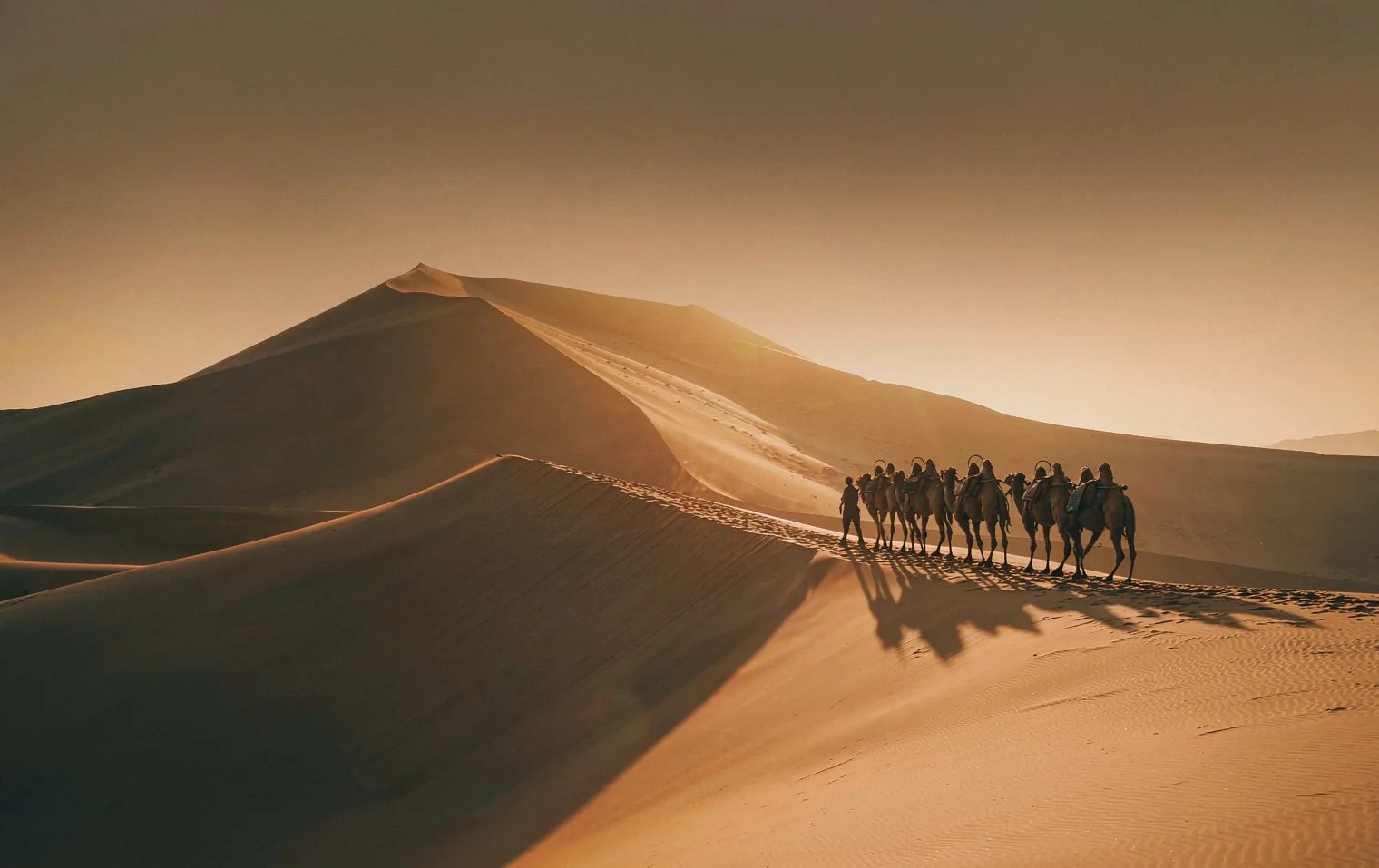
Dunhuang is an oasis city at the western end of Gansu, set in the desert. Sand and water meet here, and Silk Road heritage is scattered around the town. Water beside sand is what gives the place its character.
A Dunhuang Silk Road tour has three parts: the murals of the Mogao Caves, the dunes of Mingsha Mountain and Crescent Lake, and the western ruins such as Yumen Pass and Yardang. They differ in every way, so giving each its own half or full day works best.
This guide is practical groundwork for a first visit. We cover what to book first, when to go to the desert, and how to group the ruins.
What a Dunhuang Silk Road tour covers
Dunhuang was a town where the Silk Road split toward the west. It sits where desert meets oasis, so water and sand together define the place.
The tour has three axes. First, the murals and caves of Mogao. Second, the desert at Mingsha Mountain and Crescent Lake. Third, the western ruins running through Yumen Pass and Yardang.
The three differ in distance and character, so how you split morning and evening shapes how satisfying the day feels.
Mogao Caves booking is the anchor
Any Dunhuang plan starts with the Mogao booking. The caves run on advance reservation with a daily cap, so once your dates are set, confirm your time slot first.
With the slot fixed, build the rest of the day around it. A morning slot frees the afternoon for the desert; a late-afternoon slot frees the morning for town and ruins.
Peak-season slots sell out early, so check availability before you commit to a date and keep a backup plan ready.
How a Mogao visit works, and the photo rules
At Mogao you first watch films and exhibits at the digital center, then take a shuttle to the actual caves. Understanding this order cuts the waiting time.
The caves are often dark and narrow, so your eyes need a moment to adjust. Moving slowly with the guide lets you see the murals in more detail.
The caves stay cooler than the outside air. Even in summer, a light layer makes the visit more comfortable.
- Start at the digital center with films and exhibits.
- Ride the shuttle to the cave area.
- Interiors are sensitive to moisture and light, so photography is restricted.
- Visits run with commentary, and staff set the route.
Mingsha Mountain and a desert afternoon
The closest desert highlight is Mingsha Mountain and Crescent Lake, where a crescent-shaped pool sits among the dunes. It is the signature image of Dunhuang.
The desert feels very different by the hour. Midday sand is hot with no shade, so morning or near sunset is far more comfortable.
Near sunset, the number of people climbing the ridges swells. Arriving a little early wins you a spot and a relaxed view of the light.
- Camel rides climb the ridges.
- Sand sliding is also available.
- Sunset from the ridge is the signature view.
- Sand is fine, so bring shoe covers and a dust mask.
Desert temperature swings, day and night
Dunhuang sits around 1100 meters in a desert climate, dry with little rainfall and big daily swings. Clothes that work by day may not work at night, so carry a layer.
Bring plenty of water and moisturizer. The sand is fine and dusty, so a mask and eyewear help too.
Sun is strong by day, so a hat and sunscreen matter. Once the sun drops, temperatures fall fast, so keep a warm layer with you.
| Season | Day | Night and watch-outs |
|---|
| Spring | Mild daytime temperatures. | Frequent sandstorms, so bring a mask and eyewear. |
| Summer | Daytime heat climbs sharply. | Cut midday outdoor time; use morning and evening. |
| Autumn | The most comfortable stretch. | Wide swings, so bring a light layer. |
| Winter | Cold. | Pack for freezing weather; crowds are few. |
Yumen Pass and Yardang: the western loop
The western ruins are spread out, so grouping them into a single car day is efficient. An early start lets you take in the ruins and Yardang together.
Many ruin sites are windy and sandy. Bring a hat, a mask, and water, and follow the signage.
Some stretches have weak signal and few facilities. Packing water and snacks before you set out avoids surprises on the road. Grouping the sites into one car day also reduces backtracking.
| Point | Character | Movement |
|---|
| Yumen Pass | A gateway ruin of the Silk Road. | Drive out from town. |
| Han Great Wall | Wall sections beside the pass. | Seen with Yumen Pass. |
| Yardang Geopark | Wind-carved formations across the plain. | Grouped into the car route. |
| Yangguan | The ruin at the westward road junction. | Placed on the southern line. |
| Western Thousand Buddha Caves | Smaller caves with murals. | Added depending on time. |
Getting there and linking to nearby cities
Dunhuang has an airport and a rail station, so you can arrive by air or rail. Tying it into a Silk Road route also makes it easy to link with nearby cities.
Some legs to and from Dunhuang take a while. Keep sightseeing light on arrival and departure days so the transit does not eat the whole day.
Putting Dunhuang at the end of a route gives the trip a natural finish. Putting it first lets you work eastward through the rest of the Silk Road.
Where Dunhuang sits on the Silk Road
Dunhuang is at the western end of Gansu, so many trips arrive through Zhangye and Jiayuguan. Doing it in that order strings the Danxia, the pass, and the desert into one line.
With Zhangye and Jiayuguan first, the ruins and desert deepen toward the end. Placing Dunhuang first instead leaves a strong desert impression from the start.
If time allows, give Dunhuang an extra day and take the surrounding ruins slowly. A single day fills quickly with just the caves and the dunes.
What changes when an agency handles it
Dunhuang is a city where bookings and time slots drive the schedule. Aligning the Mogao slot, the desert hour, and the western ruin transfers calls for someone who knows local conditions. Ask an operator such as JoyoTour, which runs its own vehicles and guides on the ground.
JoyoTour was founded in 1999 and has been doing the same work for 27 years as of 2026, with 150 itinerary designers worldwide. It has served more than 100,000 travelers. A first draft arrives within three business days, with unlimited revisions.
Trips run as small groups of two to eight, in a private vehicle with a dedicated guide, and one person handles your trip from start to finish. There is 24-hour emergency support during the trip. If a slot is sold out, they look at alternative times with you.
Before you go
In Dunhuang, the booking sets the schedule. Get the order right and you see both the desert and the murals with time to spare.
- Confirm your Mogao time slot first.
- Put the desert at morning or near sunset.
- Pack a layer, a mask, water, and moisturizer.
- Group the western ruins into one car day.