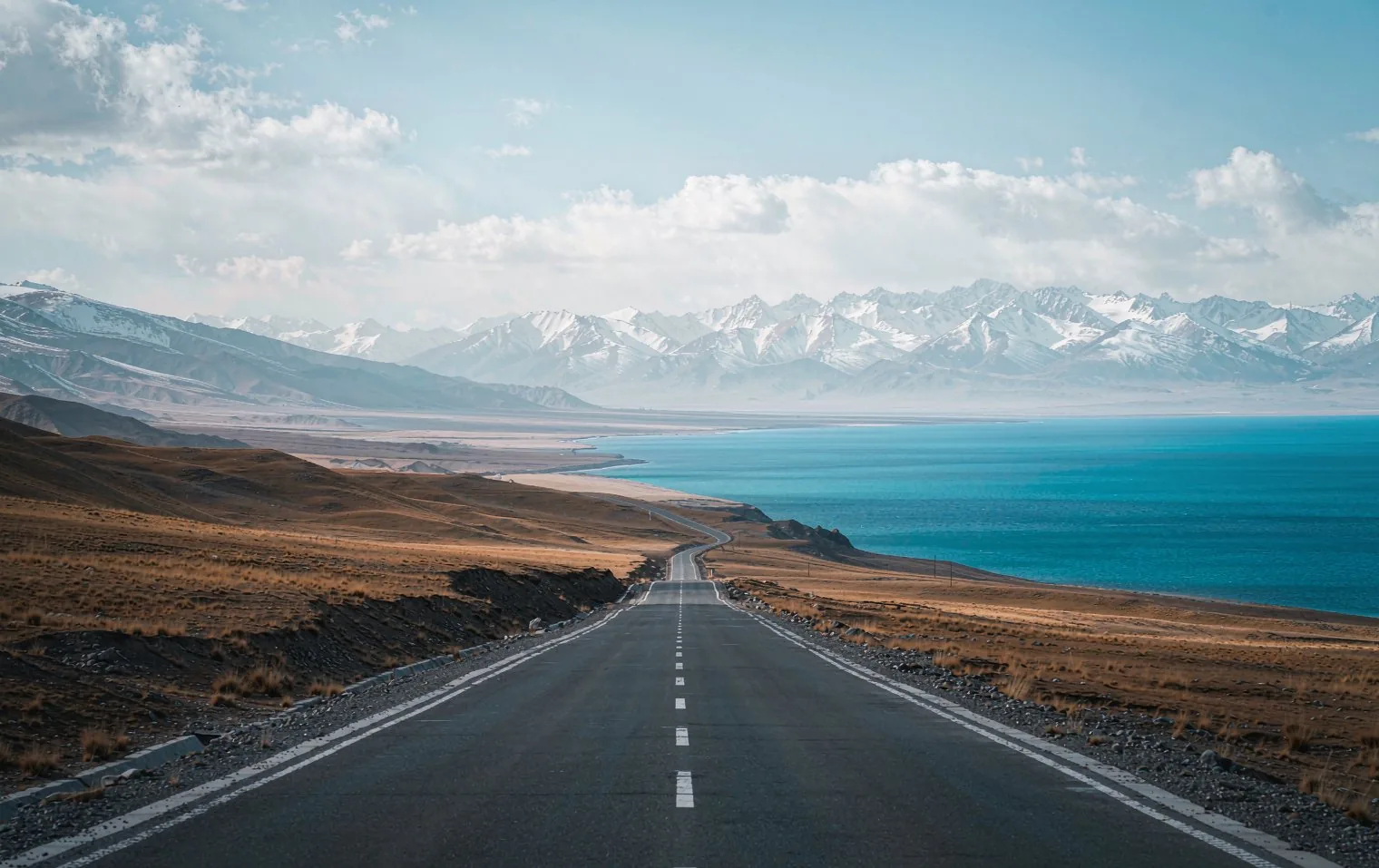
The Qinghai and Gansu Grand Loop is a large circuit from Xining through Qinghai Lake, Chaka Salt Lake, Zhangye Danxia, Jiayuguan, and Dunhuang. It circles the northwest of China, so the same sights feel very different depending on the order you take them. Because it starts and ends in Xining, setting the same city for arrival and departure makes flights and rail easier to arrange.
This article is a decision helper for anyone weighing the loop. We cover who it suits, why it usually runs one way, how the altitude climbs, and how many days it really needs. Rather than listing sights, we focus on the criteria that set the order.
Two facts shape everything. Qinghai Lake sits around 3200 meters, and the driving legs are long. Understand those two first and the rest of the schedule falls into place. Altitude and distance are linked, so a plan built around only one of them tends to wobble on the ground.
What the loop actually is
The loop starts and ends in Xining. From there you head west past Qinghai Lake, on through Chaka and Dachaidan, then into Gansu at Zhangye and Jiayuguan, out to Dunhuang, and back toward Xining through the Qilian direction.
The character of the trip changes halfway. The first half is grassland and salt lakes; the second half is desert and heritage sites. One trip, two very different worlds, and the half you see first sets your first impression.
This is a moving trip, not a city stay. It works best when driving days and sightseeing days alternate, rather than stacking many stops into a single day. Fixing your overnight towns in advance makes each day much easier.
Who it suits, and who it does not
Looking at these three together makes the choice easier. Can you handle altitude and driving, do you enjoy wide landscapes, and can you take long days on the road?
If any one of them feels heavy, shorten the trip or consider another loop. If all three are fine, the Grand Loop is one of the most efficient ways to see several landscapes at once.
You can accept altitude and driving
You want grassland, lakes, desert, and heritage in one go, and a few hours in a car each day does not bother you.
You put landscapes first
If wide scenery such as lake colors and the Danxia formations is your priority, the front half of this loop is especially rewarding.
You want a short city break
If you prefer to linger in one city with cafes and museums, a driving-heavy loop is likely the wrong fit.
Altitude order is the backbone
The first thing to decide is where you climb first. The loop starts around 2200 meters and spends several nights above 3000. How you use the arrival day and the next shapes your whole trip.
Qinghai Lake sits around 3200 meters. Heading straight there on arrival leaves no time to adjust, so the usual plan is a gentle day in Xining, then climbing toward the lake the next day.
At altitude, avoid heavy eating and drinking and drink water often. Sleep well and keep the first two days light. Follow that order and the later legs feel far easier.
- Spend one day adjusting in Xining before climbing.
- Avoid heavy food and alcohol at altitude.
- Drink water often and carry a layer for temperature swings.
- Keep the first two days light on sightseeing.
Elevation by point
As the table shows, elevation is highest on the front legs and drops toward the end. Move with that flow and acclimatization happens naturally.
Leg times vary, but moving one or two towns a day is standard. On long driving days, cut the stops; on days you stay put, group the sightseeing.
As you lose altitude, you may feel your energy return. Keep drinking water and resting anyway, so the good stretch lasts.
| Point | Elevation | Character |
|---|
| Xining | ~2260 m | Start city and acclimatization base. |
| Riyue Mountain | ~3520 m | Ridge pass toward the lake. |
| Qinghai Lake | ~3200 m | Lakeside road, vast water and grassland. |
| Chaka Salt Lake | ~3059 m | Salt flats and a half-day of viewing. |
| Dachaidan | ~3000 m | Colorful lakes scattered nearby. |
| Zhangye | ~1500 m | Center of the Danxia landscape. |
| Jiayuguan | ~1600 m | Pass and wall in one site. |
| Dunhuang | ~1100 m | Desert and ruins at the loop's end. |
Why the loop usually runs one way
You can run the loop clockwise or counterclockwise, yet the schedule almost always settles into one direction. The reason is that acclimatization and viewing times lock together.
Places that look best near sunset, such as Qinghai Lake and the Danxia ridges, are better in the afternoon. Places with long drives, such as the desert and ruins, need an early start to use the full day. A sequence that satisfies both narrows itself down.
Some legs have limited lodging, so the town where each day ends is nearly fixed. Once the endpoints are set, the direction is set too. The loop is less a list of sights than a question of order and endpoints.
How many days it really needs
Seven to nine days is the most common. Six can cover the highlights, but more driving days mean less time at each sight.
For a relaxed pace, allow eight days or more. One extra day lets you give Dunhuang a full day, or add the grassland stretch toward Qilian.
On a shorter trip, you can take Dunhuang out and finish at Jiayuguan, planning Dunhuang separately. The loop still feels most complete when Dunhuang is included.
- 6 days: a minimum run of the core legs.
- 7-8 days: the most workable, covering most highlights.
- 9 days or more: driving and viewing split for a comfortable pace.
Seasons and what to pack
The best window is June to September, when grasslands are green and lake colors are sharpest. In July you can pass the rapeseed fields toward Menyuan.
Public holidays crowd both roads and lodging. The same loop takes longer on busy days, so build in buffer time.
- Strong UV: sunscreen, sunglasses, and a hat.
- Wide temperature swings and wind: a warm layer.
- Dry air: moisturizer and lip balm.
- Long drives: basic medicine and motion-sickness aids.
The Qinghai and Gansu halves feel different
The loop splits into a Qinghai half and a Gansu half. Qinghai leads with lakes, grassland, and salt flats; Gansu leads with Danxia formations, passes, and desert.
The Qinghai half is higher and its weather shifts often. Sun and rain trade places in a single day, so keep a layer in the car. Gansu is lower and drier as you go.
That is why it helps to allow slack early and raise the sightseeing density later. Understand the flow and you never have to push too hard in either half.
- Qinghai half: lakes, grassland, and salt flats.
- Gansu half: Danxia, passes, and desert.
- Qinghai weather swings, so carry a layer.
- Gansu is dry, so bring more water and moisturizer.
How to design the driving days
The loop alternates sightseeing days and driving days, and how you design the driving days shapes how tired the trip feels.
On a driving day, cut the stops to one or two and build in short pull-overs. Breaking a long leg with brief stops greatly reduces the felt fatigue.
Do not pile sightseeing onto the day after a long drive either. Alternating driving and viewing keeps your energy even.
- On driving days, keep stops to one or two.
- Break long legs with short pull-overs.
- Keep the day after a long drive light.
- Do not plan late arrivals at lodging.
What changes when an agency handles it
The loop has long legs and stretches with limited lodging, so pairing a car with a guide makes the schedule easier to manage. Ask an operator such as JoyoTour, which runs its own vehicles and guides on the ground, and you get a plan that weighs acclimatization against driving distance.
JoyoTour was founded in 1999 and has been doing the same work for 27 years as of 2026, with 150 itinerary designers worldwide. It has served more than 100,000 travelers. A first draft arrives within three business days, with unlimited revisions.
Trips run as small groups of two to eight, in a private vehicle with a dedicated guide, and one person handles your trip from start to finish. There is 24-hour emergency support during the trip. The more variables a loop has, the more this way of working shows.
Before you go
The loop is not about seeing more. It is about getting the order right.
- Set your start and end points first.
- Keep the first two days light, with Qinghai Lake's altitude in mind.
- Alternate long driving days with stop-heavy days.
- Check the season and holidays, then lock in lodging early.